
When I first started exploring artificial intelligence, I assumed building an AI product was relatively straightforward.
The process seemed simple.
Connect an AI model to an application, send prompts, receive responses, and display the results to users.
From the outside, many AI products appear to work exactly this way.
As I spent more time building and studying AI systems, however, I discovered that successful AI products are much more than API integrations.
In fact, connecting an AI model is often the easiest part of the entire process.
The real challenge begins after that.
The Illusion of Simplicity
Modern AI APIs are incredibly powerful.
With just a few lines of code, developers can generate text, analyze content, answer questions, and perform a variety of intelligent tasks.
This simplicity has created a common misconception.
Many people believe that an AI product is simply a user interface connected to a language model.
While that approach may work for prototypes, it rarely creates a reliable product that users can depend on.
Real-world applications require much more.
Understanding User Needs
One of the first lessons I learned is that users do not care about models.
They care about results
A user doesn't open an application because it uses artificial intelligence.
They open it because they want a problem solved.
Whether the goal is writing content, analyzing data, improving SEO, or automating workflows, the technology itself is only a means to an end.
Building a successful AI product requires understanding those needs before writing a single line of code.
The Importance of System Design
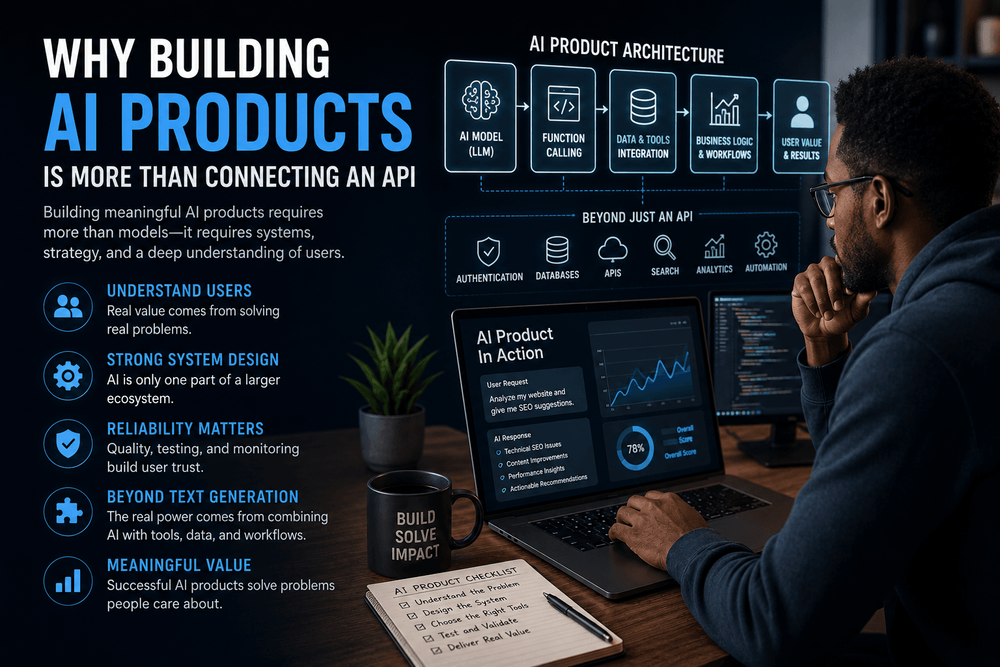
As AI applications become more advanced, architecture becomes increasingly important.
A strong AI product often includes multiple components working together.
These may include:
- Databases\
- APIs\
- Authentication systems\
- Search engines\
- Automation workflows\
- Analytics tools
The language model becomes only one part of a larger ecosystem.
The quality of the system often matters more than the intelligence of the model itself
Reliability matters
One challenge with AI systems is consistency.
Users expect reliable results.
An application that produces excellent outputs one day and poor outputs the next quickly loses trust.
To address this, developers must implement validation, testing, monitoring, and quality control.
These engineering practices are what transform experimental projects into production-ready products.
Beyond Text Generation
Many people still associate AI primarily with text generation.
However, modern AI systems can do much more.
They can:
- Search databases\
- Analyze documents\
- Call external tools\
- Process structured data\
- Automate business workflows
The most exciting applications are often those that combine reasoning with action.
This is where concepts such as function calling and tool integration become especially valuable.
Lessons l Have Leaned
As I continue exploring AI development, one lesson stands out.
The most successful AI products are not built around impressive demos.
They are built around solving real problems.
The model matters.
The prompts matter.
The technology matters.
But understanding users, designing reliable systems, and creating meaningful value matter even more.
Final Thoughts
Building AI products is about far more than connecting an API.
While modern models provide incredible capabilities, the real work involves architecture, user experience, reliability, and problem solving.
The developers who succeed in the next generation of AI applications will not simply be those with access to powerful models.
They will be the ones who learn how to transform those models into useful products that people genuinely want to use.
And in my experience, that's where the most interesting opportunities in AI development exist today.